Spring Colour, Spring Tension and Why a Heavier Spring Doesn’t Always Mean a Harder Exercise
Article by Gill Cummings-Bell BA (Hons), M.Sc., MBA, PGCE, ACSP
Download your copy of the article here!
In Part One, I looked at what a Reformer spring actually is, how it behaves and why I prefer instructors to think about spring tension, rather than simply describing springs as providing “resistance”.
If you haven’t read Part One yet, it may be worth starting there because this time I want to take things a little further.
We’re going to look at spring colours, what manufacturers actually mean by them, what a “100% spring” really means and why Classical and Contemporary Reformers can’t necessarily be compared spring for spring.
Are you confused already? Don’t worry. Let’s unpick it!
A Red Spring Is Not a Unit of Measurement
We’ve all heard it:
“Put a red spring on.”
“Use a blue.”
“Make the spring lighter.”
Within one studio, using one particular make and model of Reformer, that shorthand can be perfectly useful. The problem starts when we assume those colours mean the same thing everywhere.
They don’t.
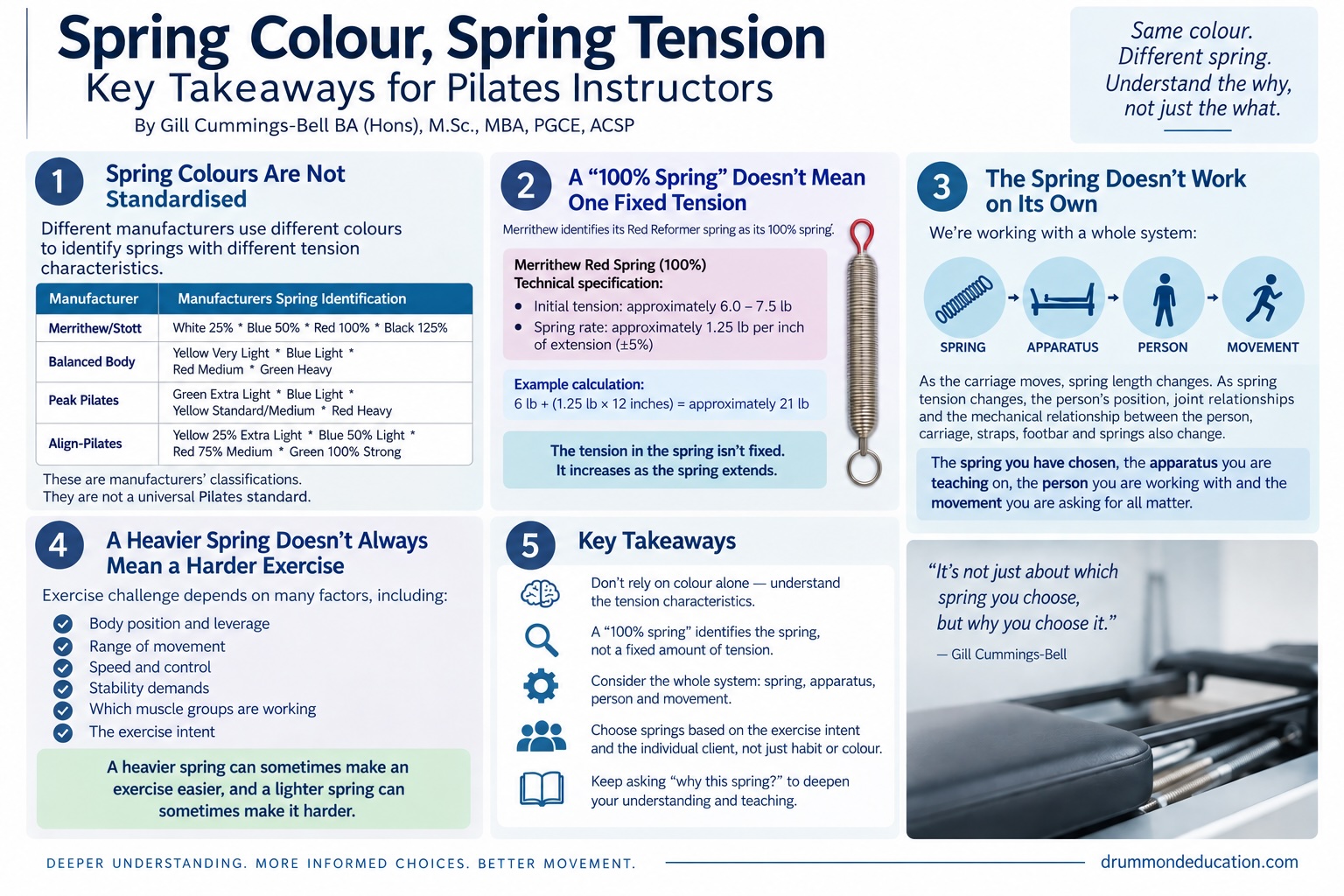
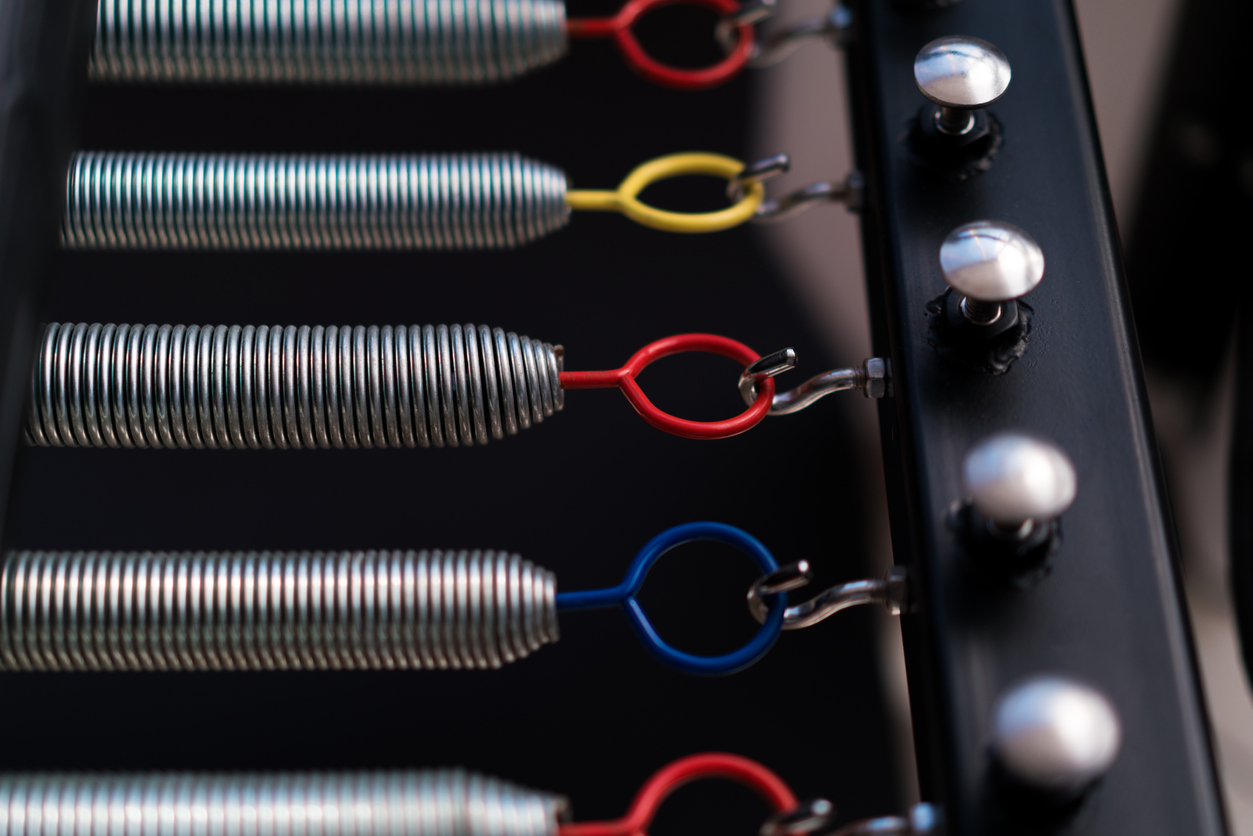
Different manufacturers use different colours to identify springs with different tension characteristics.
For example:
| Manufacturer | Manufacturers Spring Identification |
|---|---|
| Merrithew/Stott | White 25% * Blue 50% * Red 100% * Black 125% |
| Balanced Body | Yellow Very Light * Blue Light * Red Medium * Green Heavy |
| Peak Pilates | Green Extra Light * Blue Light * Yellow Standard/Medium * Red Heavy |
| Align-Pilates | Yellow 25% Extra Light * Blue 50% Light * Red 75% Medium * Green 100% Strong |
These are manufacturers’ classifications. They are not a universal Pilates standard.
So a red spring on one manufacturer’s Reformer isn’t necessarily mechanically equivalent to a red spring on another. Same colour. Different spring.
Which gives us our first important point:
SPRING COLOUR ≠ STANDARDISED SPRING TENSION
A spring colour helps us identify a particular manufacturer’s spring. It isn’t a unit of measurement. This becomes particularly important when instructors move between studios, use different makes of Reformer or attend training on equipment that differs from the apparatus they normally teach on.
If you’ve learnt an exercise as “one red spring”, you’ve learnt the spring setting for a particular piece of equipment.
You haven’t necessarily learnt why that spring has been selected or how it acheives the intent of the exercise for that client.
And for me, that’s quite a difference.
Okay, So What Does a “100% Spring” Actually Mean?
This is where it gets a little bit more interesting!
Merrithew identifies its Red Reformer spring as its 100% spring.
My first question was:
100% of what?
It would be very easy to see “100%” and assume we’re talking about one fixed amount of tension. We’re not.
Merrithew’s published technical specifications give its Red 100% Reformer spring an initial tension of approximately 6.0–7.5 lb, with a spring rate of approximately 1.25 lb for every inch of extension, ±5%.
A Tiny Bit of Science — Don’t Panic!
The initial tension is the tension already present in the spring at its specified starting position. (see part one). The spring rate tells us how much additional tension develops as the spring extends. Merrithew actually gives us a useful example.
If we use 6 lb as the starting tension and extend that spring by 12 inches:
6 lb + (1.25 lb × 12 inches) = approximately 21 lb
Still with me?
If numbers aren’t your thing, don’t worry about remembering the calculation. What I want you to remember is what it tells you.
The tension in the spring isn’t fixed.
Think of it this way…
Imagine you have hold of the end of the spring in your hand before you even start moving the carriage, you would feel the tension.
The spring isn’t sitting there doing nothing. There is already tension present.
Now start moving the carriage away. The spring stretches. As it stretches, its tension increases. So the spring you selected at the beginning of the exercise isn’t necessarily providing exactly the same tension at every point throughout the movement.
That’s the bit I want you to remember.
Saying “I’m using a 100% spring” identifies which spring you have chosen. It doesn’t mean that the spring provides one fixed amount of “100% tension” throughout the exercise.
But the Spring Doesn’t Work on Its Own
Here’s where we need to take another step into our understanding of springs. We’re not exercising against a spring sitting independently at the end of the Reformer.
We’re working with a whole system.
SPRING ↔ APPARATUS ↔ PERSON ↔ MOVEMENT
As the carriage moves, spring length changes. As spring length changes, spring tension changes. At the same time, the person’s position may change, joint relationships may change and the mechanical relationship between the person, carriage, straps, footbar and springs may also change. So even knowing the precise spring tension at one particular point still doesn’t tell us everything about the exercise.
The spring you have chosen for that exercise intent matters.
The apparatus you are teaching on matters.
The person you are teaching matters.
But before all of those comes another question:
What is the intent of the exercise within the repertoire?
Because surely our spring selection should help us achieve that intent.
Here’s the Bit That Can Catch Us Out
If we increase the spring tension in an exercise where the person is moving the carriage away and extending the springs, they may have to produce more force to achieve that movement.
But here’s my question:
Is producing more force actually what we are trying to achieve?
Within the Pilates repertoire, our purpose isn’t generally to keep increasing spring tension simply to make muscles work harder. If our primary objective is progressive muscular loading, external weights can provide a more readily quantifiable way of applying and progressing that load. There may, of course, be occasions—particularly within rehabilitation—where progressively changing spring tension gives us a very useful way of grading movement and gradually changing the demand placed upon a movement or tissue.
But that should be an intentional programming decision.
It shouldn’t simply become:
“More spring = harder workout.”
In fact, if you’re adding springs simply to make somebody work harder, stop and ask yourself why.
Are you still teaching the intent of the Pilates exercise, or have you quietly turned the Reformer into a complicated weights machine?
The purpose of the spring within Pilates is richer than simply giving the muscles something to work against.
Spring tension can be used within an exercise to support, assist, resist or control the movement, provide sensory and movement feedback, influence carriage behaviour and change what the person needs to contribute throughout the exercise. Just to name a few points of intent.
So perhaps our question shouldn’t be:
“How can I make this exercise harder?”
It should be:
“What am I trying to achieve with this exercise, and what spring tension best supports that intention?”
And What About a Lighter Spring?
Here’s another common assumption.
If I’ve reduced the spring tension, I’ve made the exercise easier.
Not necessarily.
Depending upon the exercise, reducing the spring tension may mean that the spring provides less assistance, less support or less contribution to controlling the carriage.
The person you are teaching may therefore need to contribute more muscular activation and control, not less.
Think about somebody supporting you by holding your hand while you balance on one leg doing a single leg squat.
If they gradually give you less support, the task hasn’t necessarily become easier simply because they’re applying less force.
They’ve changed what your body needs to contribute to the movement.
Spring tension can work in a similar way. Forgive the oversimplication of the explanation above.
So:
MORE SPRING TENSION DOESN’T ALWAYS MEAN A HARDER EXERCISE
and
A LIGHTER SPRING DOESN’T ALWAYS MEAN AN EASIER EXERCISE — SOMETIMES IT CAN BE HARDER
Why?
IT DEPENDS UPON WHAT THE SPRING IS DOING WITHIN THAT EXERCISE AND WHAT YOU ARE TRYING TO ACHIEVE.
From Spring Recipe to Spring Reasoning
This is where I think we need to move beyond simply remembering spring settings.
If I teach:
“Footwork is this many springs.”
or:
“This exercise is one red and one blue.”
I’ve given an instructor a recipe. That recipe may be completely appropriate on that particular apparatus. But have I taught them why? It could feel like giving a gas temperature for a recipe when someone is using an electric oven or an air fryer.
Instead, I’d like us all to start asking:
Is the spring tension being used within this exercise to support, assist, resist or control the movement or some other intent?
What happens to the movement if I increase the spring tension?
What happens if I decrease it?
Does changing the spring tension alter the original intent of the exercise?
And does my spring choice support what this exercise is intended to achieve for the person I am teaching?
That’s the difference between knowing the spring setting and understanding the spring setting.
But Hang On — What About Classical Reformers?
If you’re Classically trained, you may have been reading this and thinking:
“Gill, my springs don’t work like this!”
You’re right.
Up to this point, we’ve predominantly been talking about the multi-tension, often colour-coded spring systems commonly found on Contemporary Reformers.
Many Classical Reformers use a different approach to spring configuration.
Rather than selecting between several colour-coded light, medium and heavy Reformer springs, the traditional approach on many Classical apparatus uses equivalent Reformer springs, with the exercise setting altered principally by changing the number of springs attached. So the repertoire may call for four springs, three springs, two springs or one spring. This gives us a slightly different way of thinking about spring selection.
On many Contemporary Reformers, we can alter the spring characteristics by selecting springs manufactured to different specifications.
On many Classical Reformers, we’re more commonly altering the number of equivalent springs contributing to the exercise.
But actually, our reasoning hasn’t changed at all.
The question remains:
“Why has this spring configuration been chosen for this exercise?”
Within the Classical repertoire, the spring configuration forms part of the relationship between the person, apparatus and exercise. Change the number of springs and you change that relationship. So once again, simply asking whether we’ve made the springs “heavier” or “lighter” doesn’t really tell us enough.
We need to understand what that change does to the exercise and whether it still supports the intent of that exercise within the repertoire.
So, Can We Convert Classical Springs to Contemporary Springs?
Now this is where it gets tempting! You will find charts and teaching recommendations suggesting that a particular number of Classical springs is equivalent to a particular combination of Contemporary springs. Useful? Possibly.
An exact mechanical conversion?
That’s where I think we need to be careful.
Remember what we’ve already established. Different manufacturers may use springs with different lengths, initial tensions and spring rates. The Reformers themselves can also differ in dimensions, carriage characteristics, spring attachment arrangements and geometry.
So if somebody tells us:
“Two Classical springs equal this combination of Contemporary springs”
that may provide a useful practical starting point for teaching the repertoire on that particular apparatus. But it doesn’t mean that those two spring configurations produce identical tension throughout the movement. They may not. And even if two configurations happened to produce similar tension at one particular carriage position, that doesn’t mean they would necessarily remain equivalent as the carriage travels and the springs extend.
Different springs can develop tension differently through their extension.
Still confused? I certainly was when I first started properly unpicking this!
But I think the practical answer is actually quite simple:
DON’T TRY TO MAKE ONE REFORMER PRETEND TO BE ANOTHER.
Understand the apparatus you are teaching on. Understand the springs you have available. Understand the intent of the exercise within the repertoire. And then choose the spring tension or spring configuration that best supports that intent and the person you are teaching. If a conversion chart helps you find a sensible starting point, that’s fine.
Just don’t mistake a practical starting point for a mechanical equivalence.
Classical and Contemporary — Different Systems, Same Need to Reason
I don’t think we need to make Classical and Contemporary approaches compete with each other here. They’re different apparatus systems with different traditions, specifications and approaches to spring configuration. In the Classical system, spring configuration is closely integrated into the traditional apparatus and repertoire. Many Contemporary Reformers provide a wider choice of individual spring tensions, potentially giving the instructor more ways of changing the spring environment.
But having more choices doesn’t remove the need to understand them.
Arguably, it makes understanding them even more important.
Whether we’re selecting the number of equivalent springs on a Classical Reformer or choosing between different spring tensions on a Contemporary Reformer, I’d like us to ask the same questions:
What is the intent of the exercise?
What role is the spring tension playing within it?
What happens to the movement if I change it?
Does that change take me towards or away from the intent of the exercise?
And does it help me achieve the intended outcome for the person I am teaching?
That, for me, is where spring selection moves beyond simply knowing the repertoire and becomes part of really understanding the repertoire.
So, Where Does That Leave Us?
Perhaps with a slightly different way of choosing springs.
Rather than:
EXERCISE → MEMORISED SPRING SETTING → TEACH
I’d like us to think:
EXERCISE INTENT → SPRING SELECTION → APPARATUS → PERSON → MOVEMENT RESPONSE
And then we observe.
Did the spring choice support the intended movement?
What happened to control?
What happened to range?
What happened to the person’s movement strategy?
Did changing the spring tension take us towards or away from the intent of the exercise? And if it took us away from it, perhaps the fact that somebody once told us “this exercise is one red spring”isn’t the most useful information anymore.
The Take-Home Bit
If you’ve stayed with me through spring rates, initial tension, Classical springs and Contemporary springs, well done, were all good!
But you don’t need to remember every number.
I’d rather you remembered these take homes:
SPRING COLOUR DOESN’T TELL US A UNIVERSALISED SPRING TENSION
MORE SPRING TENSION DOESN’T ALWAYS MEAN A HARDER EXERCISE
A LIGHTER SPRING DOESN’T ALWAYS MEAN AN EASIER EXERCISE — SOMETIMES IT CAN BE HARDER
A CLASSICAL SPRING SETTING ISN’T AN EXACT CONTEMPORARY SPRING CONVERSION
The spring you choose matters. The apparatus matters. The intent of the exercise within the repertoire matters. And the person you are teaching matters.
So next time you’re about to say:
“Put a red spring on.”
perhaps stop for a second and ask yourself:
“Why?”
What is that spring tension being used to do within this exercise? What do I want the exercise to achieve? And does the spring I have chosen help me achieve it?
If we can answer those questions, we’re no longer simply following a spring recipe.
We’re reasoning.
The spring setting isn’t the reasoning. It’s the consequence of the reasoning.
Reason first. Evidence-check second. Teach only what we can defend.
Gill Cummings-Bell BA (Hons), M.Sc., MBA, PGCE, ACSP