
An evidence-informed movement & exercise matrix by Gill Cummings-Bell BA (Hon’s) M.Sc. MBA. PGCE. ACSP
Download your PDF copy by clicking here
Important context: These age bands are an educational framework, not biological thresholds. Menopausal stage, health status, genetics, training history, lifestyle and individual variation all influence when and how physiological changes occur.
The physiological picture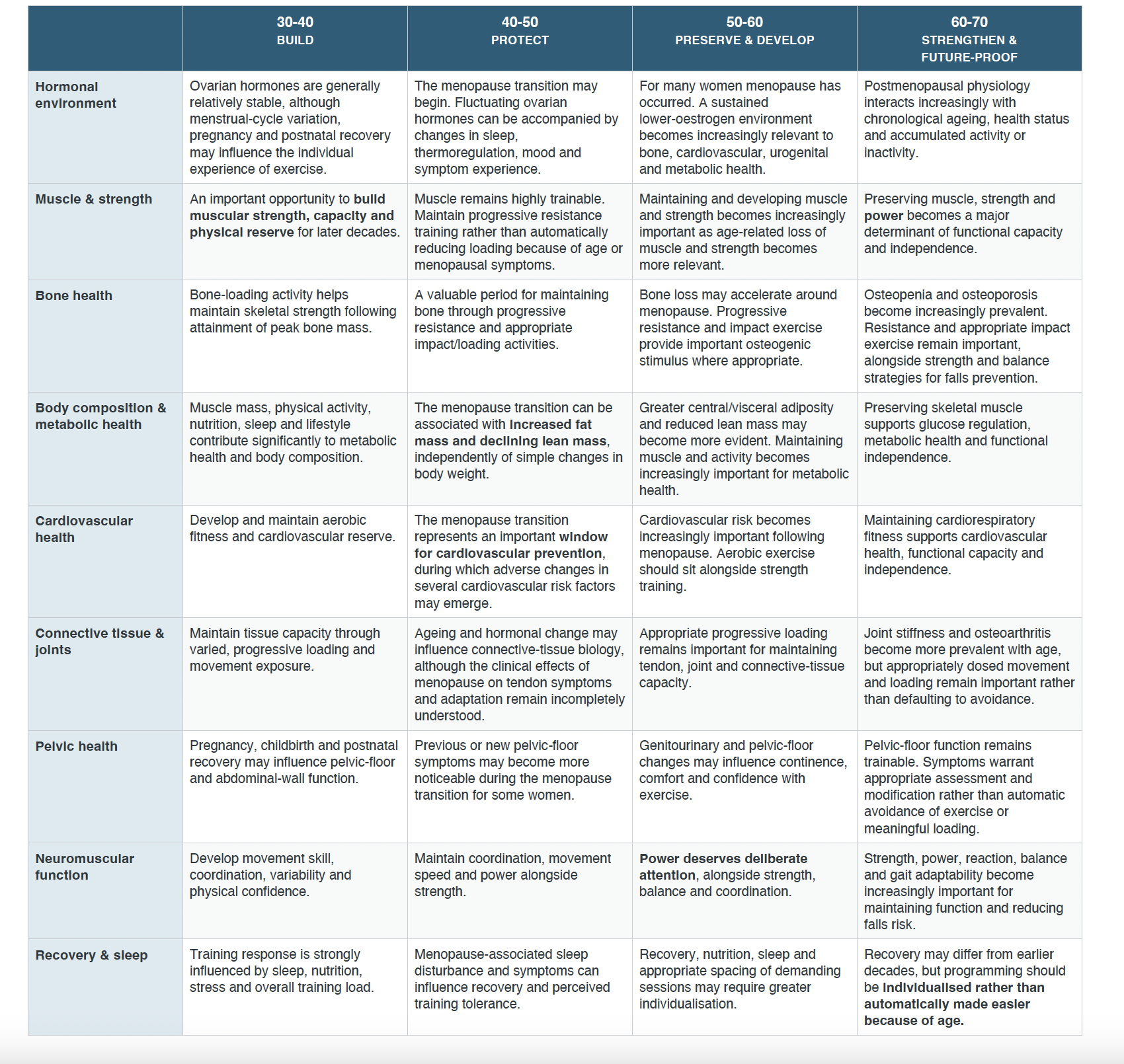
What does this mean for exercise?
30–40 | BUILD
Build the physiological reserve.
Programming emphasis: Progressive strength • multidirectional movement • appropriate impact • aerobic development • movement skill • pelvic-health awareness
40–50 | PROTECT
Protect capacity rather than protecting women from exercise.
Programming emphasis: Progressive resistance • appropriate impact • cardiovascular conditioning • power • recovery management • symptom-led modification
50–60 | PRESERVE & DEVELOP
Do not merely slow decline — continue adaptation.
Programming emphasis: Progressive resistance • bone loading • power • aerobic conditioning • balance • pelvic-health support • recovery
60–70 | STRENGTHEN & FUTURE-PROOF
Train the capabilities that preserve independence.
Programming emphasis: Strength • power • balance • gait adaptability • carrying • stepping • floor transfers • cardiovascular fitness • confidence with load
The central message
AGEING CHANGES THE PROGRAMME — IT DOESN’T REMOVE THE NEED TO TRAIN.
As women move through the decades, maintaining meaningful muscular, skeletal, cardiovascular and neuromuscular stimulus becomes increasingly important.
BUILD → PROTECT → PRESERVE & DEVELOP → STRENGTHEN & FUTURE-PROOF
Evidence note
This matrix distinguishes chronological ageing from the menopause transition. The strongest evidence supports progressive resistance training, bone-loading exercise, aerobic conditioning, balance and functional training. Claims around menopause and tendon/connective-tissue symptoms remain less certain and are intentionally expressed cautiously.
Educational resource | Drummond Education | Female Physiology Through the Decades